Your child has been dry during the day for months. Toilet training feels like it's mostly behind you. And then you realise: you're still reaching for the pull-ups every night at bedtime, with no end in sight.
If this is you, you're in extremely good company. And more importantly, there's nothing wrong with your child.
Night-time dryness and daytime toilet training are two completely separate developmental milestones. One has almost nothing to do with the other. Yet the pressure parents feel to ditch the pull-ups, often from family, childcare staff, or just a general sense that they "should be done by now," is real and relentless.
Here's the truth, and what to actually do about it.
Why Night Dryness Takes So Much Longer
Staying dry at night isn't a skill your child learns. It's a hormonal development they have no control over.
The body produces a hormone called ADH (antidiuretic hormone) that tells the kidneys to slow down urine production during sleep. In many children, this hormone doesn't kick in reliably until somewhere between ages 5 and 7, and sometimes later. Until it does, your child simply produces more wee than their bladder can hold overnight, regardless of how well trained they are during the day.
This is why most sleep experts and paediatricians don't recommend attempting night training until a child is consistently waking up with a dry pull-up for two to three weeks straight. That dry pull-up is the sign that the hormonal shift has happened. You're not training the body to do it. You're waiting for it to happen on its own.
"We tried pulling the pull-up at night when our son was 3 because everyone said he was ready. Six months of wet sheets later, we put them back on. He was dry on his own by 5 and a half, no effort at all." — Jess, Brisbane
What Age Is Normal?
Research consistently shows that around 20 percent of 5-year-olds still wet the bed regularly. By age 7, that drops to around 10 percent. And bedwetting at age 10 is still medically considered within the range of normal.
In Australia, the term used by medical professionals is "primary nocturnal enuresis," and it's one of the most common childhood issues GPs see. It runs in families. If one parent was a late night trainer, there's a good chance their child will be too.
The short version: if your 4-year-old, 5-year-old, or even 6-year-old still needs a pull-up at night, you are not behind. You are parenting a normal child.
Signs Your Child Might Actually Be Ready to Try Without
There's no magic age. Instead, watch for these signs:
- Pull-up is dry (or barely damp) most mornings for two to three weeks in a row
- Child wakes up in the night to use the toilet on their own
- Child mentions wanting to try without the pull-up
- Child is motivated and not stressed about the idea
All four together is a strong signal. One or two on their own is not enough to go on.
If your child is consistently soaked in the morning, keep the pull-up. There's no developmental benefit to removing it before the body is ready, and wet sheets every night will exhaust everyone without achieving anything.
How to Protect the Bed While You Wait
Whether you're in the pull-up phase, transitioning, or dealing with occasional accidents, protecting the mattress matters. A soaked mattress is hard to dry properly, and mould or lingering smell is a real problem in Australian humidity.
The two most practical options are:
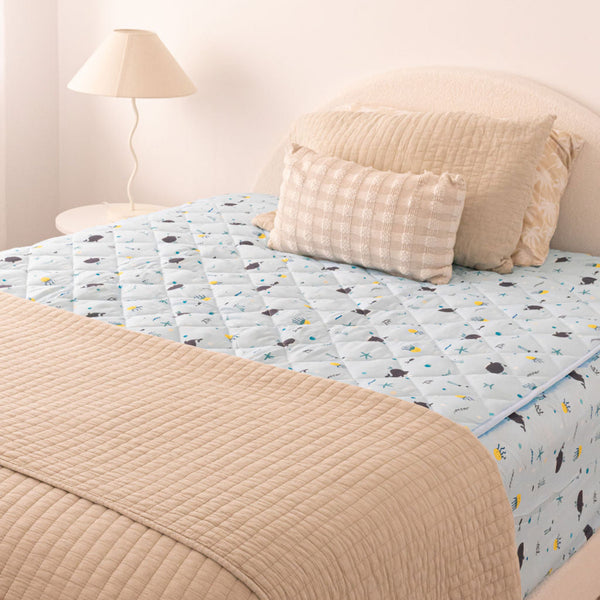
A leakproof bed guard — sits under the sheet and catches anything that gets through. Quieter and more comfortable than most mattress protectors, and machine washable. Good for kids who are transitioning and having occasional accidents rather than every-night wetting.
A leakproof fitted sheet — replaces the regular fitted sheet entirely, with a hidden waterproof layer built in. Looks and feels like a normal sheet, no crinkling, no plastic feel. Better for kids who are still regularly wet at night since you're not layering products.
Our Leakproof Bed Guards and Plush Leakproof Fitted Sheets are both designed for exactly this in-between period. Machine washable, quiet, and nothing like the plastic-backed protectors most families try first.
"We stopped stressing about the pull-up timeline when we realised the bed guard meant a wet night wasn't a big deal anymore. Pull it off in the morning, throw it in the wash, done." — Amy, Melbourne
When to See a GP
Bedwetting under age 7 rarely needs medical attention. But it's worth a GP visit if:
- Your child was previously dry at night for six or more months and has started wetting again (secondary enuresis, which can signal stress or a UTI)
- Your child is 7 or older and bedwetting is affecting their confidence, school camps, or sleep
- There are other symptoms like frequent daytime accidents, pain when weeing, or unusual thirst
There are effective treatments available for older children, including a bedwetting alarm (one of the most evidence-backed options) and in some cases short-term medication. Your GP can walk through the options based on your child's age and situation.
What to Say to Your Child
How you talk about pull-ups at night matters more than when you stop using them.
Avoid framing the pull-up as something for babies. It's a practical tool, full stop. If your child feels shame about needing one, that anxiety can actually make bedwetting harder to resolve, not easier.
A simple, matter-of-fact approach works best. Something like: "Lots of kids' bodies take a bit longer to stay dry at night. Yours is still figuring it out. That's completely normal." Then move on. Don't make it a nightly conversation.
Most children who are still in night pull-ups are already aware it's different to their peers. They don't need more reminders. They need reassurance that it's not a big deal, and that it will sort itself out in its own time.
The Bottom Line
There's no shortcut to night dryness. It happens when the body is ready, and not a moment before. Pushing it earlier than that means more stress for your child and more washing for you, with no actual developmental benefit.
Keep the pull-up until the morning dryness signals are consistently there. Protect the bed in the meantime. And try not to let anyone, family, other parents, or the internet, convince you that your child is behind.
They're not. They're just not there yet. And that's completely fine.
If you're in the transition phase and looking for practical protection that doesn't feel like you're sleeping on a plastic bag, take a look at our full toilet training range or the Toilet Training Underwear for daytime use once your child is building confidence.